Junior Cycle
On entering the College each student is assigned to a Year Head. The Year Head monitors the progress of the student, both academic and social. Parents who are concerned about the progress of their son or who wish routine reports on him are encouraged to contact the Year Head.
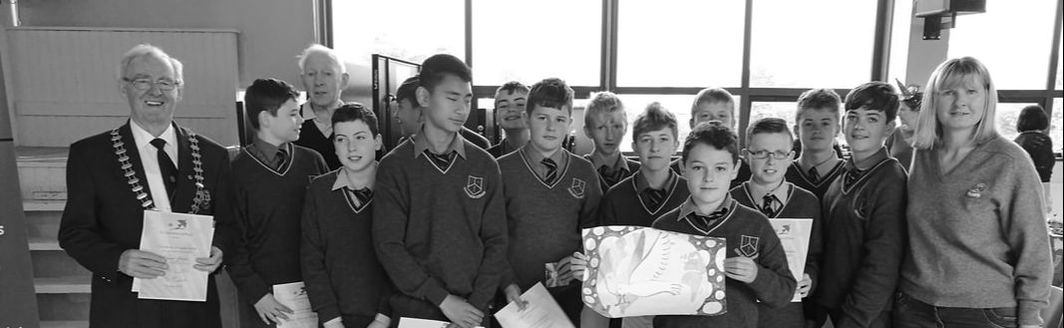
In addition, each class group (about 24 students) has a form tutor for their time over the six years in CBC. The tutor is responsible for the pastoral care programme for the group, including areas such as Health Education and Relationships and Sexuality Education. The tutor gets to know each student in the group well and is available to parents to discuss how their son is progressing in the school. The tutor-student relationship is viewed as an important aspect of school life in CBC as the relationship helps the students to develop positive bonds with staff at the college.
First Year is designed as an observation year during which pupils make the transition from Primary school to Secondary school. They are introduced to a range of new subjects and their progress is monitored during the year to establish the areas in which they show strength and the areas in which some help may be needed.
First Year is designed as an observation year during which pupils make the transition from Primary school to Secondary school. They are introduced to a range of new subjects and their progress is monitored during the year to establish the areas in which they show strength and the areas in which some help may be needed.
The core curriculum, which is taken by each pupil for the first three years leading to the Junior Certificate, consists of Religious Education, Irish, English, Mathematics, History, Geography, a Continental language (either French or German) Civic, Social and Political Education and Science. In addition each pupil follows courses in Social, Personal and Health Education.
Other subjects to which pupils are introduced include Art, Business Studies, Home Economics, Music, Latin and Technical Graphics.
These subjects are taken as introductory modules. The courses in Art, Business Studies, Home Economics, Music, Latin and Technical Graphics are planned so that pupils and parents will be in a position to make subject choices later in the term
Since First Year is an observation year, grading of students into A, B or C classes does not take place. Students are placed in a mixed-ability setting so that their strengths and weaknesses can be evaluated during the course of the year. At the end of First Year students are advised whether to take ordinary or higher courses in Irish and Mathematics.
Second and Third Year lead to the Junior Certificate and students continue to study the core subjects.
Students also take two of the following range of subjects:
Art, Business Studies, Home Economics, Music, Latin and Technical Graphics.
Other subjects to which pupils are introduced include Art, Business Studies, Home Economics, Music, Latin and Technical Graphics.
These subjects are taken as introductory modules. The courses in Art, Business Studies, Home Economics, Music, Latin and Technical Graphics are planned so that pupils and parents will be in a position to make subject choices later in the term
Since First Year is an observation year, grading of students into A, B or C classes does not take place. Students are placed in a mixed-ability setting so that their strengths and weaknesses can be evaluated during the course of the year. At the end of First Year students are advised whether to take ordinary or higher courses in Irish and Mathematics.
Second and Third Year lead to the Junior Certificate and students continue to study the core subjects.
Students also take two of the following range of subjects:
Art, Business Studies, Home Economics, Music, Latin and Technical Graphics.